
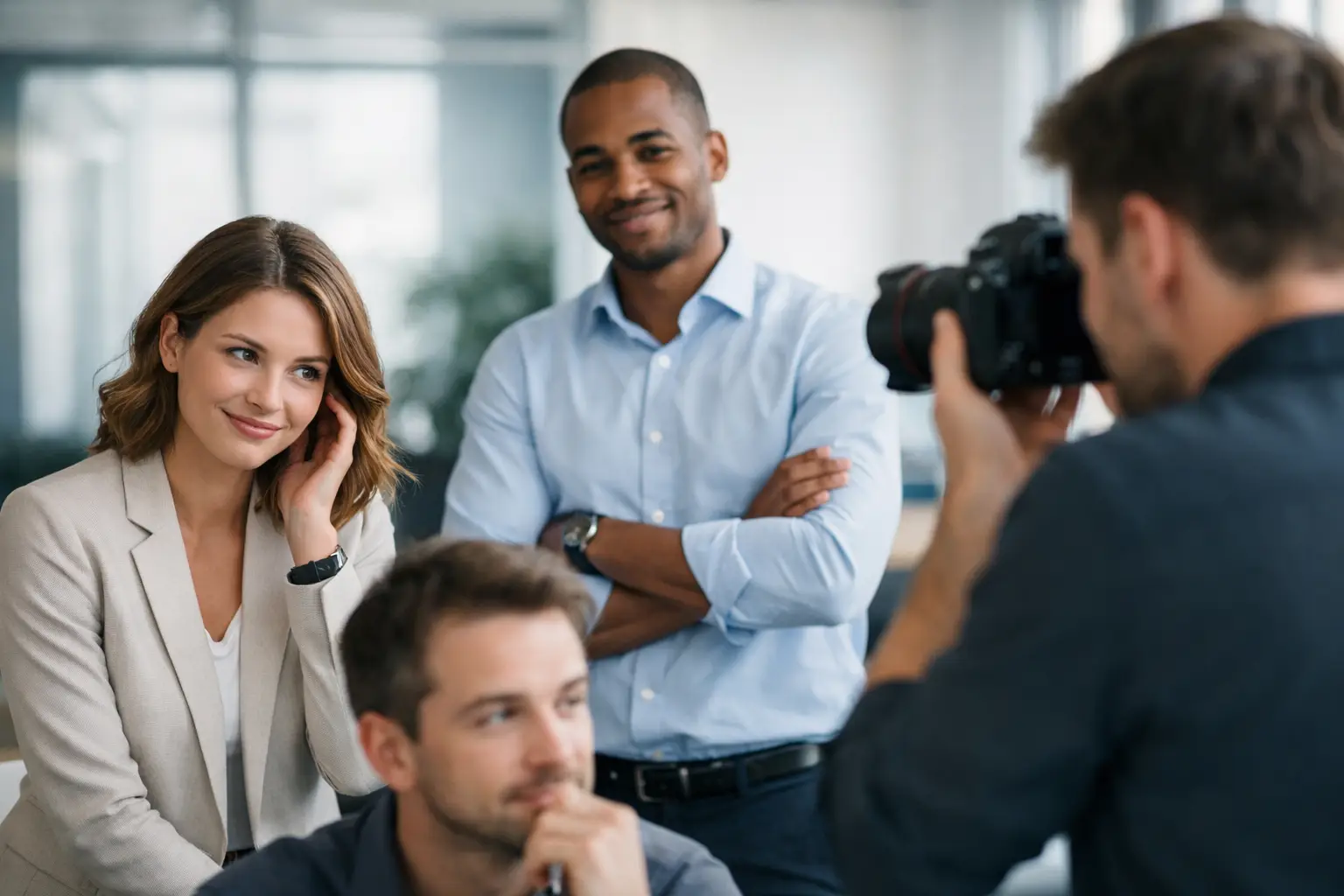
The moment most professionals tense up is not when the camera clicks. It is the few seconds before, when you are suddenly aware of your hands, your posture, your smile, and every idea you have ever had about being “bad in photos.” The good news is that posing tips for camera shy professionals are not about forcing a model-like performance. They are about small adjustments that help you look like yourself on your best day.
If you need photos for LinkedIn, your company website, speaking engagements, or brand marketing, comfort matters as much as lighting. A polished portrait should still feel human. The strongest professional images usually come from thoughtful direction, subtle movement, and a pace that gives you room to settle in.
Why camera shyness shows up in professional photos
Camera shyness is rarely vanity. More often, it is self-consciousness mixed with pressure. You know the image will represent your work, your business, or your leadership presence, so the stakes feel high. That pressure can show up as stiff shoulders, a forced smile, a locked jaw, or a pose that looks technically correct but not natural.
Professionals also tend to overthink. You may be trying to look confident, approachable, polished, and relaxed all at once. That is a lot to hold in a single frame. The answer is not to “try harder.” It is to simplify what your body is doing and let the expression follow.
Posing tips for camera shy professionals that actually work
Start with posture, not your smile
Most people focus on their face first, but posture does more of the heavy lifting. When your posture is off, your expression usually follows. Stand tall through your spine, relax your shoulders down, and think about lengthening through the crown of your head. This creates presence without looking rigid.
The trade-off is that overly straight posture can read as tense. You want structure, not stiffness. A good cue is to imagine being gently lifted upward while keeping your chest open and your shoulders easy.
Turn slightly instead of facing the camera straight on
A full front-facing pose can work, especially for stronger editorial-style portraits, but for many camera shy professionals it feels exposing. Turning your body slightly to one side tends to be more flattering and more comfortable. It adds shape, softens the frame, and gives you something intentional to do.
This does not mean twisting awkwardly. A subtle angle is enough. Your shoulders and hips should feel natural, not forced into a dramatic pose that does not suit your role or personality.
Give your hands a job
Hands are often where awkwardness becomes visible first. When people do not know what to do with them, they either press them flat against their body, let them hang heavily, or hide them completely. None of those choices look especially relaxed.
A better approach is to give your hands a simple purpose. One hand can rest lightly at your side, touch a jacket button, adjust a cuff, sit in a pocket with the thumb visible, or hold a laptop, notebook, or phone if it fits your brand. The right choice depends on the kind of image you need. A corporate headshot calls for more restraint than a personal branding session, where a little movement can feel more natural.
Shift your weight onto one leg
Even in professional portraits, a tiny bit of asymmetry helps. If you plant your weight evenly on both feet, your stance can look flat and tense. Shifting your weight slightly onto one leg creates a more natural line through the body and helps your shoulders and arms relax.
This is one of the simplest posing tips for camera shy professionals because it changes how you feel, not just how you look. The body usually settles faster when it is not trying to stay perfectly square.
Lean from the waist just a touch
A slight forward lean can make a portrait feel more engaged and confident. It brings energy into the frame and helps avoid the look of pulling away from the camera. This is especially effective in headshots and seated portraits.
The key is subtlety. Too much lean can feel aggressive or uncomfortable. Think of it as moving your attention forward, not your entire body lunging toward the lens.
Expression matters more than a big smile
Many professionals assume they need a broad smile to look friendly. In reality, a natural expression is usually more credible than a smile you are working hard to hold. A soft smile, a calm mouth, or a relaxed almost-smile often photographs better than something overly cheerful.
Confidence on camera is less about looking happy and more about looking present. Let your face settle between shots. Breathe. Think about a person you genuinely enjoy speaking with or the kind of client interaction that brings out your best energy. That mental shift often changes the expression more effectively than being told to “smile.”
Relax your jaw and eyes
Tension gathers in small places. A clenched jaw or overly wide eyes can make an otherwise strong portrait feel strained. Before the shot, inhale, exhale, loosen your jaw, and blink once or twice. These tiny resets matter.
It also helps to avoid freezing in place. If you hold the same expression too long, it starts to look fixed. The best portraits often happen in the moment just after movement, when the face has not had time to become stiff again.
Use movement to avoid stiffness
The biggest myth about posing is that it should be still. In fact, light movement often creates the most natural results. Turning your shoulders slightly, taking a slow breath, adjusting your jacket, or shifting your stance between frames can make you look far more at ease.
This is especially helpful for professionals who say they feel awkward the second they are asked to pose. Movement gives your body a rhythm and keeps you from over-managing every detail. It also allows the photographer to capture more authentic transitions instead of a single held position.
Choose poses that fit the purpose of the image
Not every professional portrait should feel the same. A founder headshot for a website might call for direct eye contact and steady posture. A branding image for social media might feel better with more motion, softer expression, or environmental context. A team photo may need consistency more than individuality.
That is where posing becomes strategic. The best pose is not just flattering. It matches how you want to be perceived. If your work is highly relational, approachable body language matters. If your role requires authority and precision, cleaner lines may suit you better. Neither is right for everyone.
Clothing affects posing more than people expect
What you wear changes how you stand, sit, and move. If your jacket pulls, your shirt gaps, or your shoes throw off your balance, discomfort will show up in the final images. Well-fitted clothing supports better posture and helps you move naturally.
This does not mean formal is always better. It means appropriate and comfortable usually wins. Professionals tend to photograph best in clothing that feels like a polished version of what they would actually wear to meet an important client or represent their business.
Let direction do its job
People who are camera shy often think they need to arrive knowing exactly how to pose. You do not. A thoughtfully guided session should take that pressure off you. Clear cues like where to place your hands, how to angle your shoulders, or when to soften your expression can make a huge difference.
At Fotoreflection, that guided experience is a big part of helping professionals feel relaxed enough to look natural. The goal is not to make you perform. It is to create an environment where confidence has room to show up.
What to do right before the camera clicks
Give yourself one simple checklist. Drop your shoulders. Shift your weight. Breathe out. Soften your jaw. Think of connection, not perfection. That is usually enough.
If you try to control every feature at once, you will look controlled. If you focus on one grounded physical cue and let the rest follow, the image tends to feel more real. That is the balance camera shy professionals need most – polished, yes, but still unmistakably themselves.
The best professional photos are not the ones where you look most posed. They are the ones where you look comfortable being seen.